


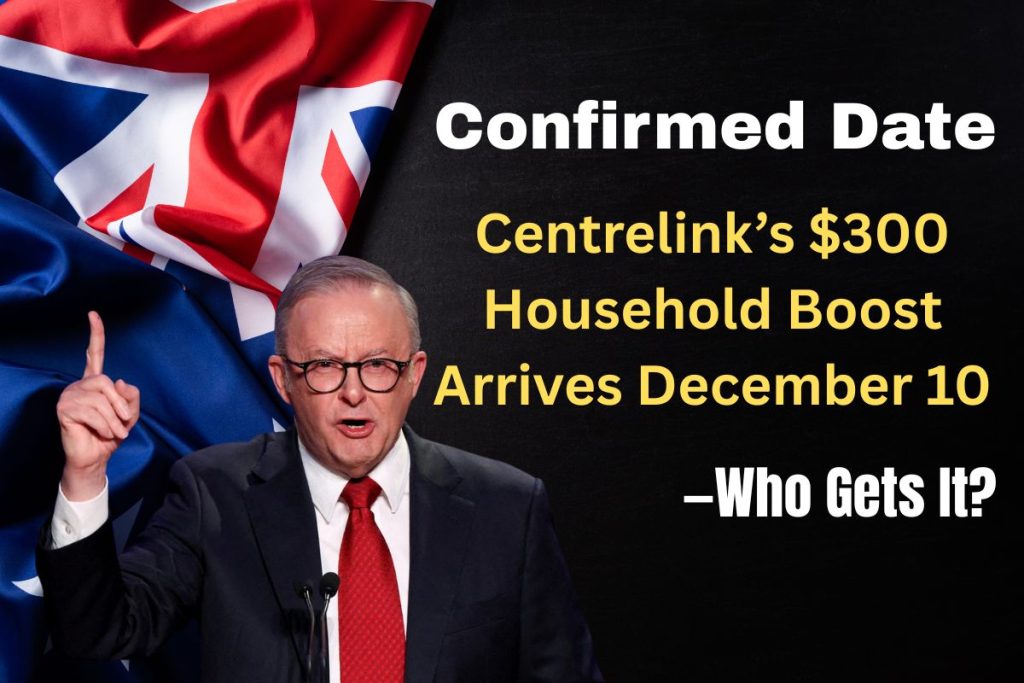
Australia’s 300 dollars Centrelink Household Boost is scheduled to be deposited into the bank accounts on December 10, 2025. It will offer you an instant cash boost to cover increasing living expenses and the end of year costs. It is not necessary to apply separately since the money will be immediately if you have an eligible Centrelink benefit or have an approved concession card.
The government has presented this as a specific cost-of-living relief for lower and middle-income households that are suffering due to food, rent and fuel prices. This means for you, the $300 was designed to provide an immediate relief and not as a long-term boost however, it could be a significant contribution to your budget for December when you think about it and ensure that all of your Centrelink and MyGov information current.
What is the $300 Household Boost?
The Household Boost of $300 is a once-in-a-lifetime Centrelink-linked cash payment scheduled until December 10, 2025, to help Australian households that are struggling with high day-today expenses. It’s part of the larger national rebates for energy and cost of living however it is promoted as a direct cash boost that will be available before Christmas for eligible Centrelink customers.
It can be used as a little “safety buffer” to cover the essentials such as groceries and school supplies, as well as petrol or even a portion of your electric bill instead of a regular source of income. Because it’s processed electronically it is not required to fill out additional appointment or forms, so long as your current Centrelink claim is in effect and your bank information is accurate.
$300 Household Boost Key Highlights
| Detail | What you should be aware of |
| Name of the payment | One-time $300 Centrelink Cash Boost for Households to assist to alleviate the pressure of cost-of-living. |
| Confirmed payment date | The plan is to open the bank accounts of banks that are eligible on 10 December 2025. |
| The amount you get | The flat fee is $300 per household or a qualified Centrelink customer for a one-time payment. |
| Who are the people it is targeting | Centrelink beneficiaries such as Age Pension, Disability Support Pension, JobSeeker, Youth Allowance, Parenting Payment and similar categories. |
| Do you require an application? | No additional application required; pay in a single payment with your existing Centrelink account. |
| What is the method of payment? | Direct deposit to your chosen bank account, which is separate from your regular fortnightly benefit. |
| Connection to Energy Relief | It is a part of the larger $300 energy bill relief program as well as other cost-of living measures. |
| What should you do now? | Keep MyGov, bank information and income information up-to-date keep an eye on your account for changes around the 10th of December. |
| Official Website | https://my.gov.au/ |
$300 Household Boost Confirmed Payment Date
The cash boost is set to go live on the 10th of December in 2025. It will coincide with the regular Centrelink payments so that it will be processed quickly into bank accounts that are eligible. In real life this means that you must be watching your MyGov inbox and your bank account for the date of that with a little bit of patience dependent on the bank’s processing time.
If you’re paid in a different cycle however, the $300 is scheduled to be received in a single, one-time cash-in at the time of the confirmed date instead of being spread across several weeks. You can look up your online statement on Centrelink or your online banking account to view the exact amount and verify that the boost is in place.
Who Can Get the $300 Boost?
The program is targeted towards households already enrolled in the welfare system, which means the chances of receiving the benefit are greatest if you have the qualifying Centrelink payment. According to reports, people who are receiving age pension, Disability Support Employment Allowance, Pensions, Jobseeker Parenting Payment and other income-support benefits will be eligible, subject to final conditions.
You might also be eligible for specific concession or health card plans which are typically used to help with cost-of-living however, you will still have to be able to prove residency and follow standard Centrelink guidelines. Short-term or temporary visa holders are typically not eligible for these kinds of one-off boosts except if they have already been approved for regular Centrelink payments.
$300 Household Boost Eligibility Criteria
In order to be eligible for Centrelink, you require an active or accepted Centrelink payment or a recognized concession status at the time of the cut-off date of the government’s cut-off time, which runs to 10 December. This means you shouldn’t have cancelled, suspended or late reviews on your claim before the run of payment is being completed.
Also, you need to satisfy the standard requirements for residency and identity that include having a residence in Australia and residing legally in a visa category that is eligible. Although asset and income tests aren’t unique to be eligible for the $300 increase however, the underlying payment (like the Job Seeker and Retirement Pension) does have these restrictions, so you need to stay within those guidelines to ensure that you are eligible.
How the $300 is Paid to You
Contrary to the $300 national energy bill relief, which appears as credit on your electricity bill This Centrelink Household Boost is set as a direct transfer in your banking account. The amount should appear as distinct of your normal weekly benefit, which makes it simple to recognize.
There is no need to make a special claim or fill out an additional application form as the system will use your existing Centrelink information to determine who is eligible. The most important thing for you to take is to ensure that your account with a bank, contact information and income details up-to-date in MyGov to ensure that the system is able to pay you with no errors or delays.
How Does This Work With Other Cost-of-living Help
The December $300 installment is in conjunction with other measures of 2025 relief, such as continuing energy rebates and small business credit programs aimed at reducing power bills as well as general living expenses. A lot of households will receive support by reducing their electricity bills and cash-style increases like this one in particular if you’re already receiving concessional or Centrelink payment.
If you’re a retired or career looking, you may benefit from the recent increase in indexation as well as additional bonuses that have been announced which, when combined, boost your total annual support. Making use of the December $300 smartly, such as to pay off priority bills can help get those higher increases into the new year.
How You Can Prepare and Use the Boost
Start by drafting your December budget in a straightforward way which includes your normal Centrelink payment, plus an additional $300, so that you can clearly see where the money will make the greatest impact. Many households prefer to take advantage of one-time boosts for overdue bills rent, rent gaps or groceries that are essential instead of splurges because this reduces stress in the new year.
Also, make sure whether you are able to verify that any Centrelink reports (such as income reports to JobSeeker as well as youth Allowance) is filed on time, which means your claim is active once the payment is accepted. If you are sharing bills within the same household, you should talk to your household members or friends about utilizing the additional $300 to pay for shared expenses like internet, electricity or fuel to ensure everyone gets a fair share in a fair way.
It’s the possibility of a $300 Centrelink increase that is scheduled to be available on the 10th of December in 2025. It is targeted at helping you cope with rising costs in one of the highest-cost seasons during the entire year. There is no need to take any steps to get it. Just ensure that your MyGov account, bank and eligibility information up to date to allow the money to be deposited smoothly into your account. By planning out how you’ll make use of this cash today, and adding it to other ongoing cost-of-living assistance and other support, you can transform one $300 investment into an actual breathing room to your household budget.
FAQ’s
1. Do I have to submit separate application to get paid $300 Centrelink household Boost?
There is no need to submit a separate application because the boost will be paid out automatically to the eligible Centrelink or concession card holders, whose information are already registered in the system.
2. How will this $300 affect my regular Centrelink tax or payment?
The increase can be described as one-time cost-of-living assistance payment. It’s generally regarded as an independent payment from the normal rate calculation therefore it cannot be intended to lower your current entitlement. These types of welfare benefits generally are tax-free for recipients of social security However, you must check your eligibility with your ATO and a tax professional to determine your specific circumstance.
3. What do I do if $300 doesn’t show up on your bank account?
If you’re eligible, and the funds have not been received within a few days following the 10th of December, examine your MyGov messages and your online Centrelink account for notifications about your claim. If you are unable to find a reason for the delay, call Services Australia or visit a service centre with an updated identification and bank information so that they can check your records and track the payment.



Leave a Reply